Can an AI Agent Design a Chip? Building a Benchmark That Says No to Shortcuts
Most coding benchmarks end when the tests pass. Hardware does not work that way. A processor that computes the right answer still has to be fast, small and frugal with energy, and those goals pull against each other. We built oai-bench to ask a harder question than "can a model write Verilog": can an agent take an architectural specification all the way to a routed layout, making the tradeoffs a real design team would make along the way?
- What it is. Agents get an XML architecture and ISA contract, an independent Python reference and public workloads. They must explore with executable timing models, write synthesizable RTL, pass a trusted checker, and submit before a deadline. A pinned OpenROAD flow on the ASAP7 predictive 7 nm process then measures area, clock and workload energy.
- Score. Correctness is a gate. Passing designs are ranked by
1 / (1 + time × energy × area)in fixed units, at a clock period the design declares and must meet after routing. - Anti-gaming. The CPU private tier grew from 27 to 547 cases: 500 constrained-random programs, randomized memory timing, four hidden CoreMark-style kernels and an in-order retirement trace. On GPU SIMT, a formal gate rejected a mutant that passed every one of its 71 simulation cases.
- Teams vs one agent. In one exploratory CPU pair on an uncalibrated image, a 7-role team scored 0.1821 against a single agent's 0.1757, using 6.3× the model responses. We have no retained real-model GPU SIMT comparison yet, and we say so below.
- Tasks. Two physically scored and calibrated tasks (CPU, GPU SIMT), three correctness-gated accelerators (Tensor, RT, Vector), a NoC in development and about thirty planned. We want contributors: section 07 shows how to add one.
Contents · 01 Why chip design · 02 The tasks · 03 How an episode works · 04 Scoring · 05 Making the score hard to game · 06 Teams vs one agent, with run traces · 07 Add a task · 08 What we learned · 09 What's next · Notes
01Why chip design
Correctness is precise and checkable. An instruction set defines exactly what every instruction does, including overflow, alignment and faults, so no grader has to judge prose.
Correctness is also not enough, and everything else is measurable. A correct design still has to close timing, fit an area budget and spend little energy on real workloads, and open tools can measure all of that. That yields a continuous score with real tradeoffs: a deeper pipeline may run faster but cost area; a cache may save memory stalls but burn energy.
And the work is long. A competent attempt models options, writes and verifies RTL, iterates on physical results and decides when to stop, over hours under a fixed budget. That tests planning and follow-through as much as RTL skill.
02The tasks
| Task | What the agent builds | ISA | Status | Physical score | Held-out kernels | Cases (public / private) |
|---|---|---|---|---|---|---|
| CPU | 32-bit integer core, 16 registers, separate 4 KiB instruction and data memories | 31 | Scored and calibrated | Yes | 4 | 92 / 547 |
| GPU SIMT | 2 warps × 4 logical lanes, structured divergence, shuffles, ballots, barriers | 27 | Scored and calibrated, formal gate | Yes | 5 | 66 / 71 |
| Tensor Core | Streaming INT8 matrix multiply, exact INT32 accumulation, 16×16 tiles | 7 | Correctness-gated | Not yet | 3 | 17 / 20 |
| RT Core | Closest-hit and occlusion queries over a BVH, exact rational arithmetic | 3 | Correctness-gated | Not yet | 4 | 37 / 41 |
| Vector Core | Fixed-point vectors, 48-bit accumulators, gathers, permutations, reductions | 15 | Correctness-gated | Not yet | 4 | 30 / 34 |
| Network-on-Chip | 8 endpoints, request and reply classes, 64-bit flits, fixed 160 µm die | 2 | In development (branch) | Authored, not merged | 0 | 23 / 23 |
| About 30 planned blocks | Softmax, quantized GEMM, memory and cache controllers, prefetcher, TLB, DMA, coherence, NPU SoCs | Planned |
Table 1. Task catalog as of 8 October 2026. Private counts are at the calibration seed and include the held-out kernels.1
Every task leaves the microarchitecture open. The contracts say what the hardware must compute, never how many pipeline stages, lanes or execution units to build. The GPU contract defines logical lanes, and the candidate decides how many physical lanes exist; the NoC contract prescribes no topology or routing algorithm. The NoC branch already has two very different fixtures: an input-queued crossbar (7,656 µm², 1.545 ns, reward 0.223) and a mesh (12,381 µm², 0.982 ns, reward 0.113).2
The planned list is organized by what the agent may change (only the design, also the ISA, or the whole architecture) and by size (block, cluster, SoC). All five merged tasks sit in the smallest cell: fixed ISA, single block.
03How an episode works
Each task is defined by three things. An architecture contract in XML owns state, memory interfaces, reset and termination. A separate ISA contract owns encodings and exact instruction effects. An independent Python reference, the Untimed Reference, executes programs and returns the expected architectural result with no notion of clocks.
<instruction mnemonic="ADD" opcode="0x01" format="r3" role="compute">
  <semantics>rd = u32(rs1 + rs2).</semantics>
</instruction>
An entry from the CPU ISA contract. ADD is opcode 0x01 in the three-register format, and its semantics say rd gets rs1 + rs2 wrapped to 32 bits. The Untimed Reference executes this line directly, and the agent's RTL must match it.
Encoding metadata is shared with assemblers and decoders, but the semantic text is never executed; the reference implements it independently.
The agent works in a container with no network access, the contracts read-only under /public and a writable /workspace.
The image includes Python, C++, gem5, Icarus, Verilator, Yosys, OpenROAD and KLayout.
  Explore               Implement             Measure                 Submit
+----------------+    +----------------+    +--------------------+    +------------------+
| Timing Models  |--->| RTL + Model    |--->| public_check       |--->| submit           |
| model-only     |    | Spec + Graph   |    | Netlist, Lockstep, |    | Latest Accepted  |
| cycle checks   |    |                |    | Formal; optional   |    | -> Private       |
+----------------+    +----------------+    | Route, STA, Power  |    |    Grading       |
        ^                                   +---------+----------+    +------------------+
        |                  Iterate                    |
        +---------------------------------------------+
Figure 0. One episode, from contract to graded checkpoint.
The agent must first write an executable Candidate Timing Model in Python or C++ that predicts its microarchitecture's cycles and hardware counters.
It can compare several on the public workloads before any RTL exists.
Then it writes RTL and calls public_check.
The harness synthesizes an immutable snapshot into a canonical netlist, simulates it in a trusted testbench, compares results with the reference, and replays the agent's timing model one clock edge at a time against the recorded RTL trace.
Pins, cycle counts and counters must all agree, so an agent cannot just claim its design is fast.
With physical scoring configured, a passing design can go through placement, clock-tree synthesis, routing, parasitic extraction and sign-off timing on ASAP7 cells, then a workload replay on the routed netlist for energy.
Finally the agent must call submit.
At the deadline its containers are torn down and the latest accepted checkpoint goes to Private Grading with a seed it never saw.
Unsubmitted work does not count, and there is no hidden best-of selection.
04Scoring
cost   = (T / 1 µs) × (E / 1 nJ) × (A / 10,000 µm²)
reward = 1 / (1 + cost)
T is mean execution time across weighted workloads, E is mean execution energy and A is placed area.
The scales are units, not targets from a reference design, so we never had to freeze a "good" answer.
With equal exponents, halving execution time exactly compensates for doubling area.
The submission declares its own clock period, and that one period drives simulation, the timing model, synthesis, routing, power replay and scored time. If routed timing fails at the declared period, the design fails; grading never falls back to a slower clock. Memory latency is stated in picoseconds (2,500 ps on the CPU task) and converted to whole cycles at the declared clock, so a faster clock adds wait states rather than making memory faster.
| Calibrated fixture | Cases | Declared / achieved | Setup / hold slack | Area | Mean time | Mean energy | Reward |
|---|---|---|---|---|---|---|---|
| CPU | 547 | 1.360 / 1.298 ns 735 / 770 MHz |
+63.8 / +18.0 ps | 5,437 µm² | 5,906 ns | 14.3 nJ | 0.0213 |
| GPU SIMT | 71 | 1.520 / 1.503 ns 658 / 665 MHz |
+18.5 / +21.1 ps | 12,683 µm² | 6,440 ns | 35.6 nJ | 0.0034 |
Table 2. The current workload_product_v5 calibrations. They show the pipeline works; they are not targets.4
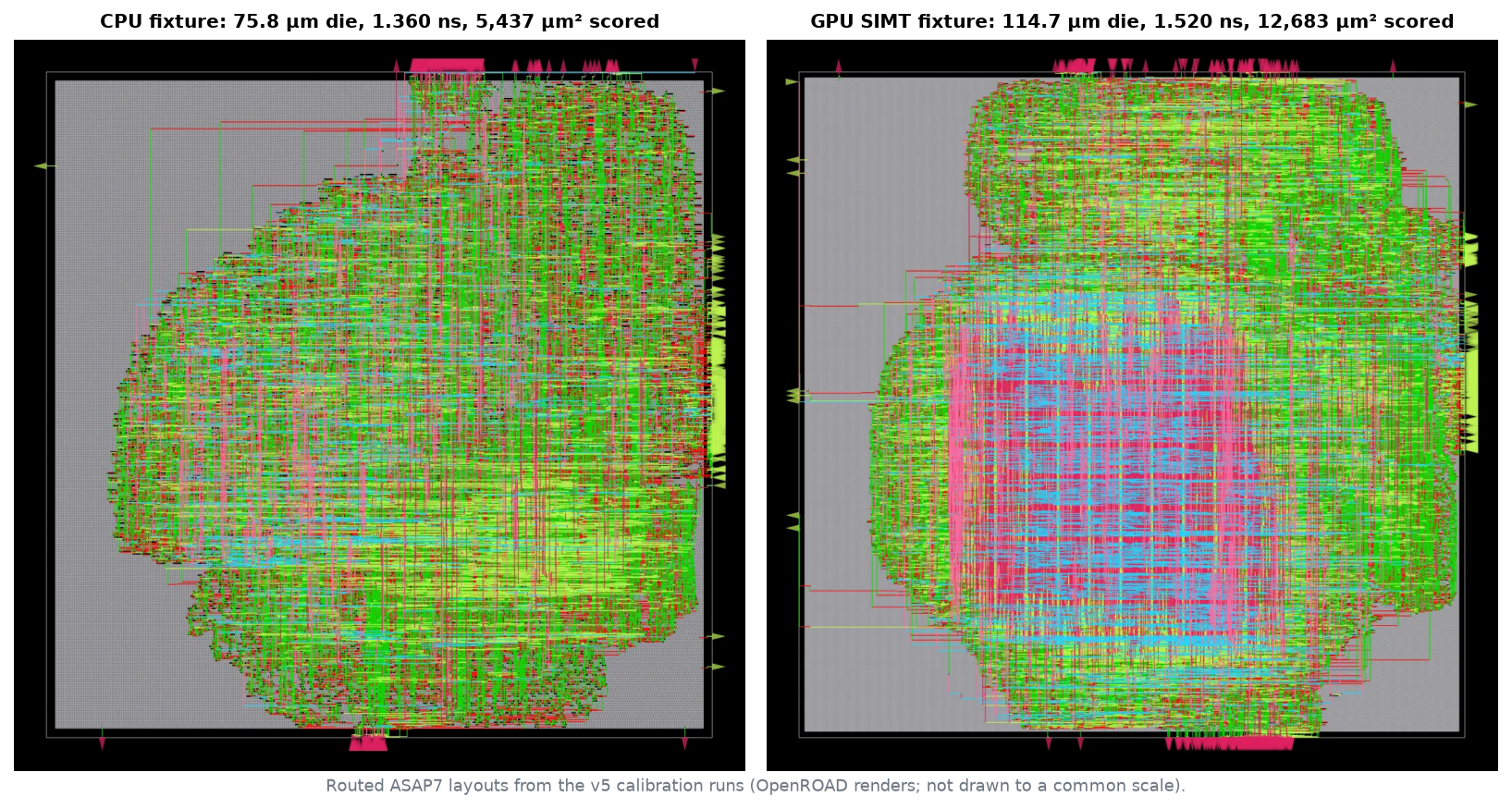
Scored area counts every placed instance, including fill and tap cells. The CPU fixture's logic cells alone cover about 1,774 µm² of its 5,437 µm².
05Making the score hard to game
Agents find the cheapest path to a passing check, so much of the project went into writing dishonest designs and making sure the grader catches them. Every row below is a cheat we built and ran through the real checker.
| Cheat | Passes | Caught by | Result |
|---|---|---|---|
| "Lazy decoder" that checks reserved bits only for the opcode in the fixed fault case | every fixed and fuzz case | 500 constrained-random programs generated from the ISA contract | fails |
| Ignores the memory ready signal | all 27 fixed cases | randomized per-request latency and gating | fails 11 to 13 of 16 generated cases, by seed |
| Assumes fixed memory latency | all 27 fixed cases | same | fails 16 of 16 |
| Recognizes the public sum loop by its PC and skips it | right final state | in-order retirement trace checked against the reference and bus traffic | fails |
| Withdraws a stalled GPU instruction fetch after one edge | all 71 simulation cases | bounded SymbiYosys gate on the canonical netlist | score 0.0 |
| Memorizes public workloads | everything public | four hidden CPU kernels and five hidden GPU kernels, redrawn each seed | no credit for memorizing |
Table 3. Cheats and what catches them.5
Some details matter more than they look.
- Random programs are biased toward hazards: load-use, writes to r0, boundary immediates and store-load aliasing. About 20% plan a fault, and unreachable words are filled with illegal opcodes and stray jumps.
- Held-out kernels are normalized by the reference's retired-instruction count. Each CPU instance retires 10,000 to 16,000 instructions, and the size of the draw does not move the score.
- Retirement ports are simulation-only. The physical flow strips them and their exclusive logic, so honest tracing costs no area.
- Grading seeds are per campaign. A review found that every preset used one constant seed, so anyone who learned it could enumerate the private tier from the public generator. Seeds now derive from an operator secret, and a test scans every written file for both.
- One leak came from our own tooling. The dashboard served captured task sources, which would have exposed the hidden kernel generator. It is fixed and covered by a test.
A formal pass is only as good as its depth. The CPU formal check stays warn-only because it is inconclusive on our honest fixture past about ten cycles, and a design whose first retirement comes late can pass it vacuously. A formal failure is meaningful there; a pass is not yet.
06Teams vs one agent, with run traces
The benchmark runs in two modes with the same deadline, resources and sign-off rules. A single generalist can do everything. Or a team of seven roles, each with its own conversation and workspace, splits the work:
| Role | Owns |
|---|---|
| VP | Schedule, assignments, scope cuts, the fallback submission, improvement rounds |
| Architect | Design direction and the lever ranking after each measured candidate |
| Microarchitect | Concrete resources and timing; freezes the spec and resource graph |
| Performance | Timing models, discriminating experiments, reconciling predictions with RTL |
| RTL | An early checked baseline, then each next candidate |
| Verification | Test plan in parallel with RTL, reproducible bug reports, coverage sign-off |
| Physical design | Placement plan, physical checks and sign-off; the only role that may start the physical flow |
The team coordinates through versioned releases, each published with trusted evidence.
A performance study needs at least two passing model checks from distinct models; an RTL candidate needs a passing public_check.
Sign-off is derived, not declared: every required release must be current and its evidence must match the exact netlist being submitted.
Roles activate only when their input releases exist, and an open change request from any role blocks submission until it is resolved or the VP waives it.
The VP's prompt is blunt about the main risk: "an idle perf or microarch is the most common way a team stalls."
Results
| CPU, single agent | CPU, 7-role team | GPU SIMT, single agent | GPU SIMT, team | |
|---|---|---|---|---|
| Hidden cases | 27/27 | 27/27 | no retained run | no retained run |
Reward (workload_product_v3) |
0.1757 | 0.1821 | ||
| Achieved clock period | 1.590 ns | 1.527 ns | ||
| Area | 5,888 µm² | 5,925 µm² | ||
| Mean job time | 1,618 ns | 1,555 ns | ||
| Mean execution energy | 4.92 nJ | 4.87 nJ | ||
| Model responses | 134 | 848 | ||
| Output / input tokens | 36K / 12.2M | 157K / 67.2M | ||
| Graded checkpoint | 2nd submission, ~3.2 h | baseline, 69 min | ||
| How it ended | declared complete | crashed at 2.1 h |
Table 4. Real-model episodes of the same model, one per arm, 5-hour budget.6
The CPU pair ran on a rebuilt, uncalibrated toolchain image with 27 hidden cases, before the random gate and held-out kernels existed. Its numbers compare only with each other, not with the calibrated fixtures above, and there is one episode per arm.
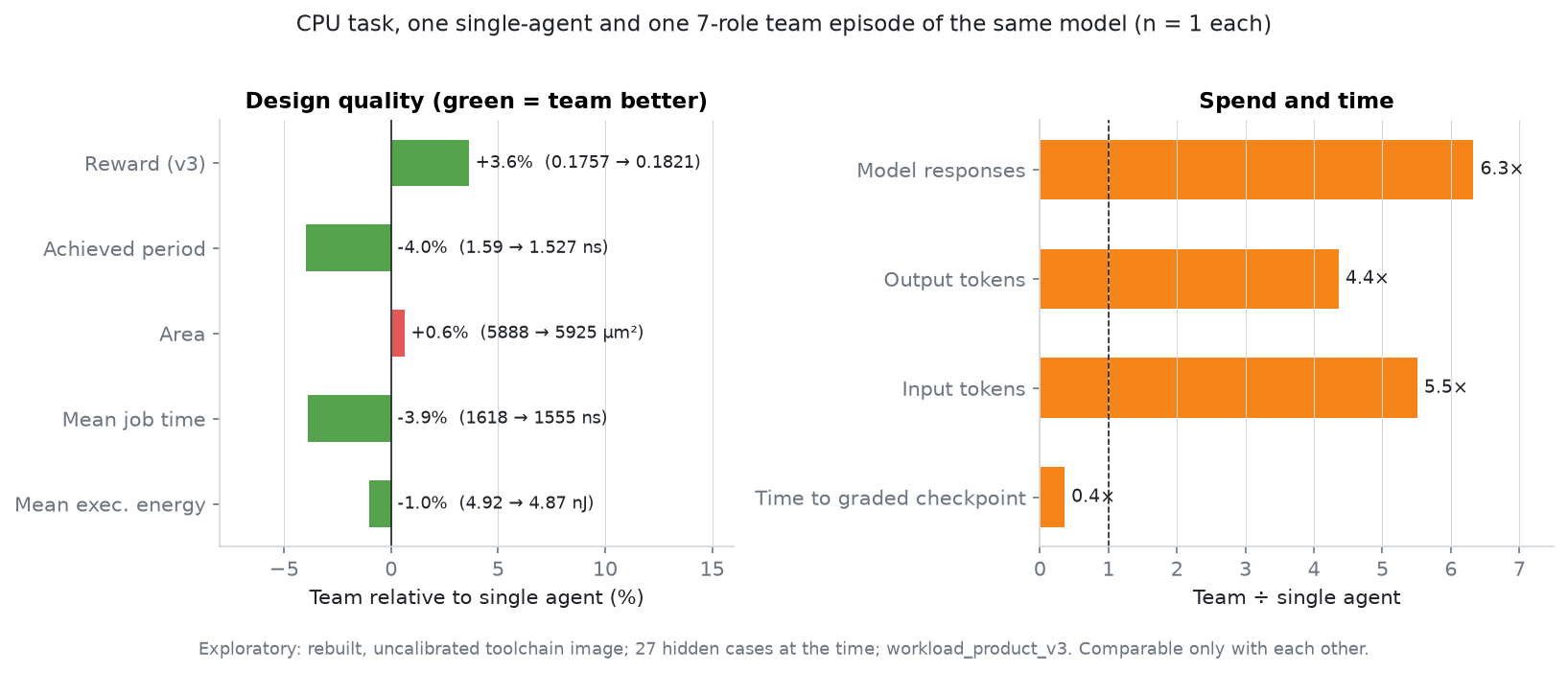
On CPU, the team found a faster clock (−4.0%) and slightly lower energy at almost the same area, for a 3.6% higher reward. It paid for that with 6.3× the model responses and 5.5× the input tokens. Before crashing, the team had also passed a physical check on an unsubmitted three-line fetch-cache variant at 0.1858. It was graded on its 69-minute baseline because the VP had locked that in first, which is exactly what its prompt asks for.
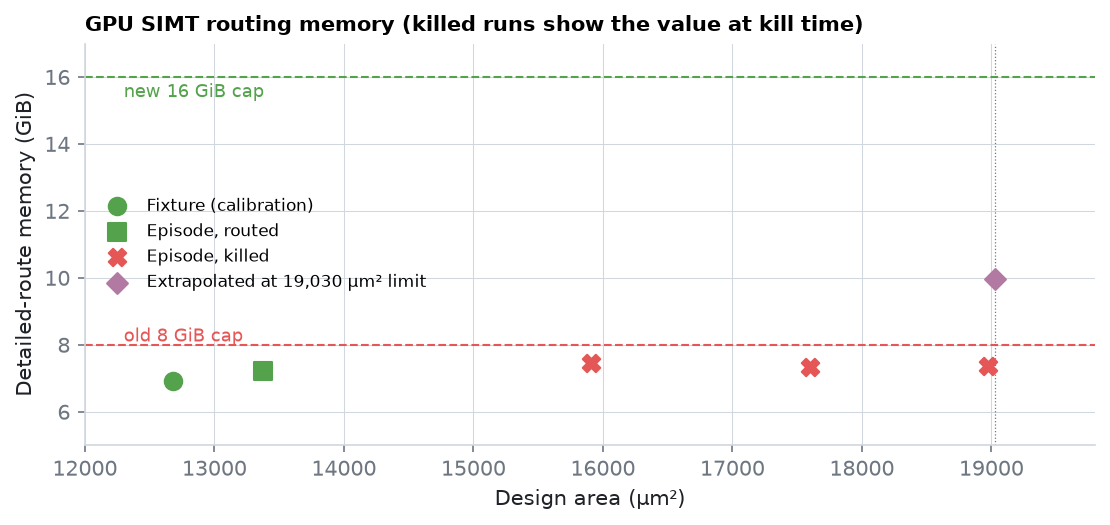
For GPU SIMT there is no retained real-model comparison between a single agent and a team. Single-agent and team GPU SIMT episodes were scheduled in a long-horizon campaign, but our records keep only their routing measurements, without agent mode, score or transcript. Routing records cannot establish team or single-agent scores, so we report none. What survives is still informative about the designs themselves: those episodes produced routed designs from 13,379 to 18,976 µm², all larger than our 12,683 µm² fixture, and three of them were killed by the routing memory cap (Figure 6).
Run traces
We do not have full turn-by-turn transcripts of these real-model runs on hand, so the traces below come from the closest retained records: an audit of a team run, grader output, harness logs and scripted episodes run through the real harness. Each is labeled.
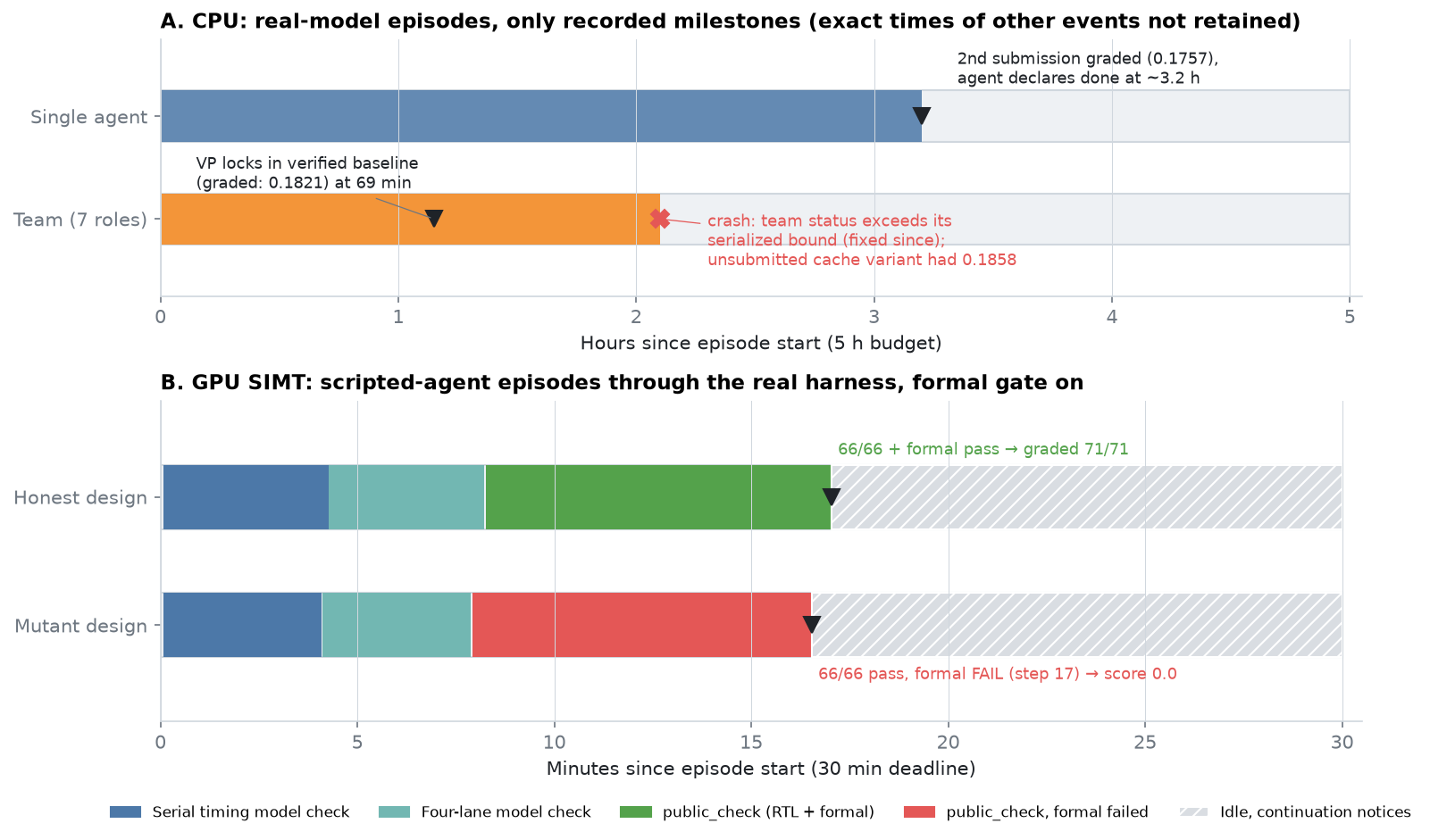
Trace 1: a handoff that failed (CPU team, earlier functional-only audit). A shorter 30-minute team run with no physical grading lost every case to one missed handoff. From the audit of its shared room:
seq 2872  Perf: the model emits fetch-valid during reset; the latest RTL uses an IDLE state to suppress it.
event     Perf completes its assignment.
seq 2915  VP asks for a model patch in chat, without reactivating Perf.
seq 2924  VP integrates the stale model with the newer RTL and submits.
grader    timing mismatch at cycle 0 tick: imem_req_valid rtl=0, model=1   (0/27 cases)
The right role found the bug and reported it in the room. It was lost because a chat message does not wake a finished specialist. The same run spent 19 yield calls and 16 unchanged polls waiting, about 469K input tokens.7 This is why sign-off is now derived from evidence that matches the exact submitted netlist, rather than from a role saying it is done.
Trace 2: the team idles during sign-off (CPU team pair). The whole team sat idle through a 48-minute physical check, about 16% of its wall time. The VP and workflow prompts now keep three design generations in flight: one in sign-off, one being built, one being modeled.
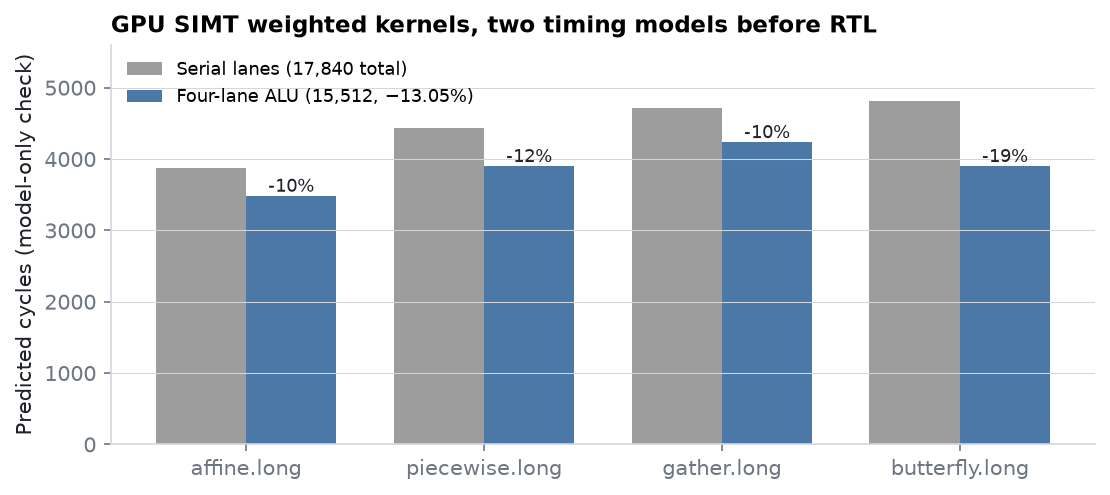
Trace 3: exploration before RTL (GPU SIMT, scripted agent). The scripted fixture measures two timing models on all 66 public cases before writing RTL:
   4.7 s  public_model_check /workspace/models/serial
 255.9 s  -> passed, 66 cases, model_id serialized-gpu-simt, cycles 36072
 256.9 s  public_model_check /workspace/models/parallel
 493.4 s  -> passed, 66 cases, model_id parallel-gpu-simt, cycles 31176
 495.7 s  public_check include_physical=False
1022.4 s  -> passed, 66/66, formal passed, cycles 36072
1022.5 s  submit -> accepted
Trace 4: the formal gate catches what simulation missed (GPU SIMT, scripted mutant). The mutant withdraws a stalled instruction fetch after one clock edge. It passes all 66 public cases, and later all 71 private ones. The bounded formal gate fails it on every check:
SBY [run] engine_0 (abc bmc3) returned FAIL
SBY [run] failed assertion ... gpu_formal_protocol_progress_protocol_terminal.sv:325 step 17
SBY [run] DONE (FAIL, rc=2)
The violated property, from the generated harness:
// Stalled requests keep their complete payload until accepted.
always @* if (live && past_imem_stall) begin
    assert (imem_req_valid);
    assert (imem_req_addr == past_imem_addr);
end
Final record: passed_cases = 71, formal.outcome = design_failed, score.value = 0.0.
The two barrier checks also failed, at steps 243 and 123, on the property that every warp eventually reaches a terminal state.
Each check took 25 to 29 seconds.8
After submitting, the scripted agent kept replying without tool calls, and the coordinator answered each reply with a continuation notice:
Clock: 13.5 of 30.0 min remain; deadline 2026-10-02T20:38:55Z.
Accepted submission (graded unless replaced): checkpoint 8208…, no public measurement of that checkpoint.
Observed trusted job durations: public_check median 513 s, max 513 s; public_model_check median 232 s, max 239 s.
A reply without tool calls never ends a timed episode; the agent is told how much time is left and what a check costs.
Trace 5: timing closure on the reference fixtures (harness, not an agent). The physical-design lesson came from our own fixtures. Declaring a design at its earlier achieved clock failed sign-off: the CPU at 1,294 ps by 2.65 ps of setup slack, the GPU at 1,406 ps by 40.9 ps. Timing repair stopped at zero estimated slack, and the estimate was off by −39 to +30 ps after global routing.
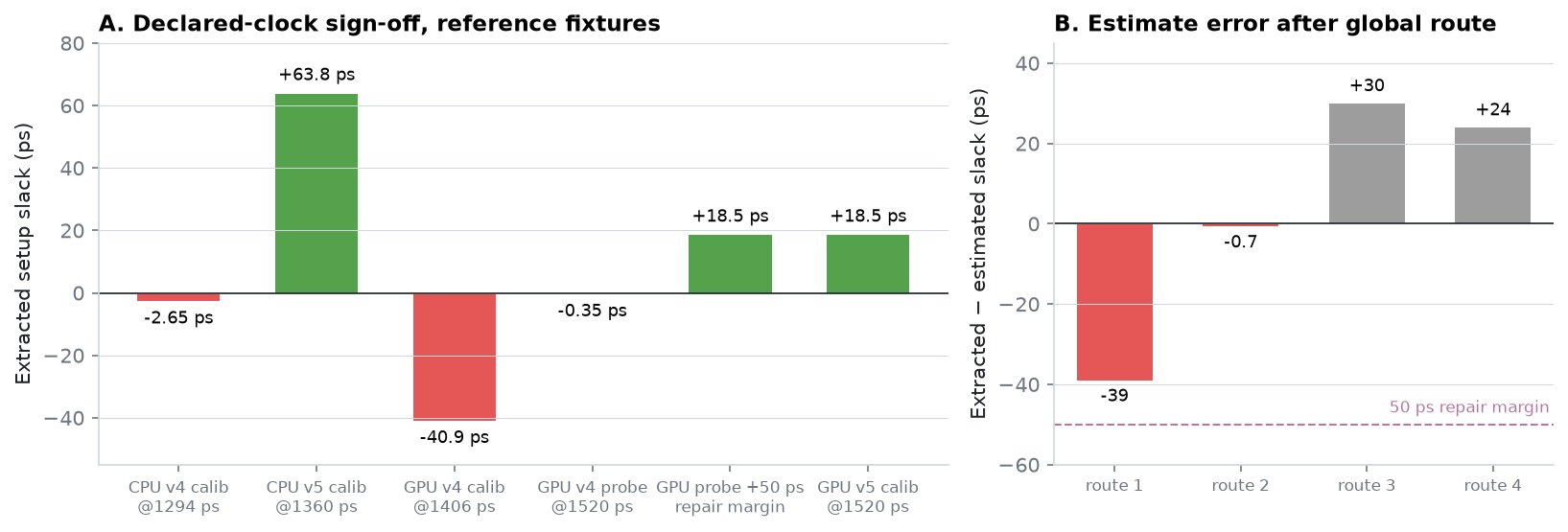
Repair now closes to 50 ps of estimated margin, sign-off still requires only nonnegative extracted slack, and the defaults declare periods about 5% above their first routes.
07Add a task
We would like the task list to grow faster than we can grow it ourselves. A good task has precise observable behavior, room for real microarchitectural choices, workloads that pull those choices in different directions, and adversarial cases.
tasks/<id>/
  task.toml                identity, contract paths, hooks, profiles, public and hidden files
  prompt.md                task-specific instructions captured into episodes
  arch/arch.xml            state, interfaces, memory, reset, termination, counters
  arch/isa.xml             encodings and exact effects
  reference/reference.py   independent Untimed Reference
  workloads/cases.py       seeded public cases
  workloads/heldout.py     private scored kernels (optional)
  dv/                      RTL contract, trusted execution and audit, model/RTL lockstep
  profiles/*.toml          memory service, workload weights, [scoring] once calibrated
  tests/                   task tests, mutants that must fail, coverage map
tests/fixtures/<id>_submission/   reference RTL, timing model, spec, resource graph
- Contracts and reference. Write the architecture and ISA XML and an independent Python reference, then validate them:
sh
   uv sync --locked --extra shared
   uv run oai-bench validate tasks/<id> --seed 0
   uv run oai-bench run-reference tasks/<id> --seed 0 --output work/runs/<id>-reference
   uv run oai-bench verify-run work/runs/<id>-reference
   uv run oai-bench view tasks/<id>
- Fixture and checker. Build a plain reference RTL and timing model, then run them through the real evaluator:
sh
   uv run oai-bench models run tasks/<id> tests/fixtures/<id>_submission \
     --image "$OAI_BENCH_IMAGE" --output work/model-runs/<id>
   uv run oai-bench check-rtl tasks/<id> tests/fixtures/<id>_submission \
     --image "$OAI_BENCH_IMAGE" --output work/runs/<id>-rtl
   uv run oai-bench verify-evaluation work/runs/<id>-rtl
-
Mutants. Add deliberately wrong RTL and models (arithmetic, timing, counters, protocol) and show that each fails through the real checker. Map every requirement to a test in
tests/coverage.md. -
Calibration, for a physical score. Add a
[power]replay hook and a[scoring]profile. Then run a local smoke case, a physical probe at the declared clock, and a full calibration over every graded case. Only a complete calibration with routed workload power, nonnegative slack and confirmed cleanup qualifies a profile.
There is no generic calibrator yet; each scored task has its own script, and the NoC branch added one. The loader also requires an ISA, so ISA-free blocks need a small extension first. Correctness-gated tasks are welcome without a physical objective.
The task-authoring prompts in skills/prompts/ walk through ideation, generation and an end-to-end episode, and docs/README.md is the documentation entry point.
08What we learned
Most failures are capacity, not correctness. Three GPU SIMT episode designs were killed at an 8 GiB routing memory cap. One CPU calibration ran for 4.5 hours, then failed exporting 1.3 GB of evidence past a 1 GiB bound. Seven concurrent power sessions under one memory cap got one of them killed. We treat these as unavailable infrastructure, never as a zero for the design, because confusing the two would quietly punish large designs.
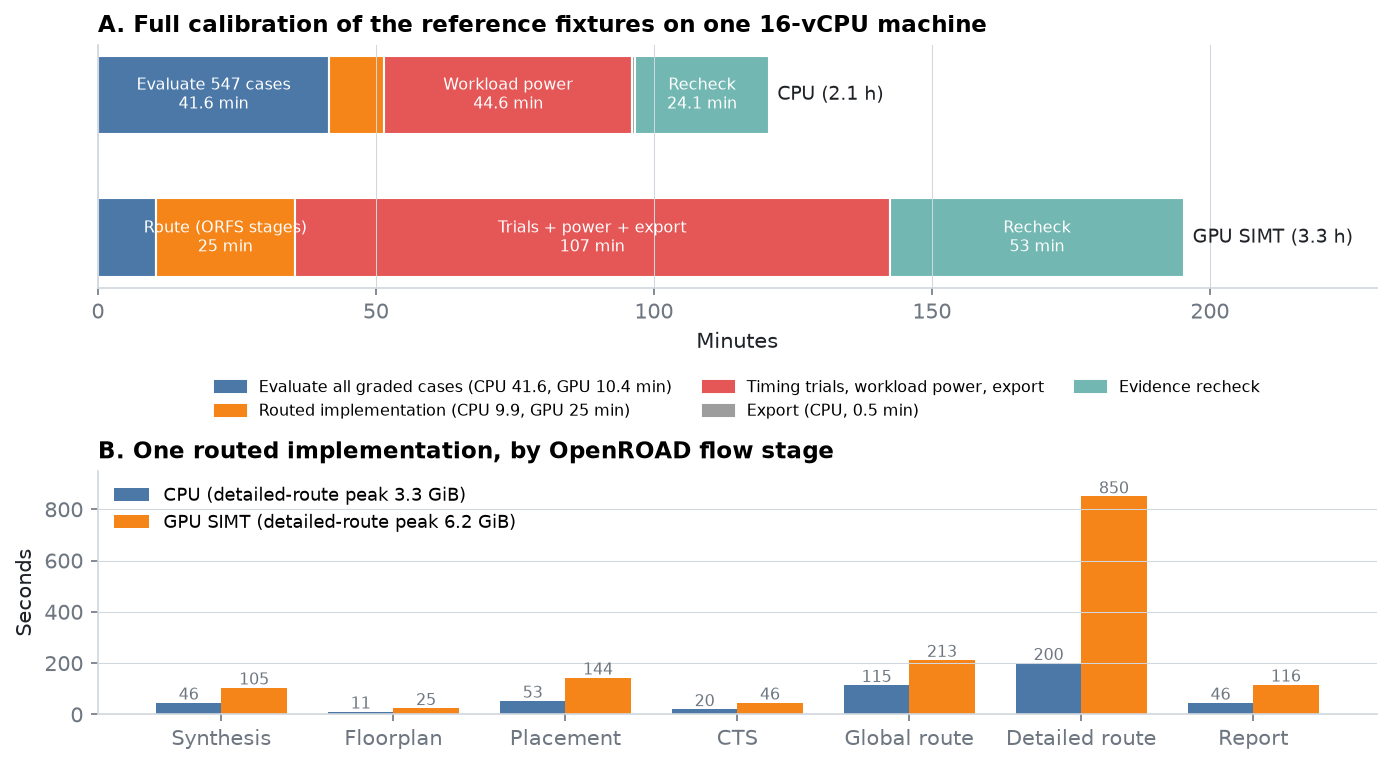
Calibration is slow, so tune the flow first. A full calibration runs every graded case and the whole physical flow. Detailed routing dominates the routed implementation, and workload power dominates the rest. Every CPU repair call reached its best result within 500 attempts, so moving from 2,000 attempts on two threads to 500 on eight cut routing time from 2,740 to 923 seconds with a byte-identical netlist. A power-measurement cache later made activity replay 2.7 to 3.3 times faster with bit-identical results.
Flakiness lives in the harness. Routing was reproducible: the CPU netlist was byte-identical at two and eight threads. The scaffolding around it was less reliable. Simulator output truncated under host load, a test run ignored SIGTERM and left orphaned simulators, an operating-system auto-update restarted a live episode about 20 minutes in, and a team status message outgrew its size bound and ended a run. Each became a fix and a test.
Write down why each prompt rule exists. Every behavior rule in our prompts maps to an observed failure:
| Rule | Failure it corrects |
|---|---|
| Rank levers by predicted change in log cost | A single agent read energy as its biggest lever and tuned energy and area for hours while cycles stayed flat |
| Keep a structural model experiment running during every long check | A third of a single agent's episode passed waiting on its own jobs |
| Structure before tuning | Tuning gave single-digit gains; structural changes gave tens of percent |
| Convergence needs a computed bound | Agents declared designs finished hours early; a sibling run later found 22% more |
| Three generations in flight | Teams improved only while the VP happened to reassign exploration |
Table 5. From the prompt behavior-design table.10
09What's next
- More episodes, calibrated. The single-agent vs team question needs several calibrated episodes per arm on both CPU and GPU SIMT, with full evidence retained.
- Physical scores for the accelerators. Tensor, RT and Vector Core need calibrated objectives before they can be ranked.
- NoC. Finishing and merging the task, including its fixed-die floorplan and per-task flow capacity.
- A formal verification role. A planned eighth role focused on unbounded proofs. The trusted reference owns the obligations and assumptions; the agent supplies only lemmas, which must be proven, never assumed. Formal stays a gate, never a reward term. Local dry runs behave as intended: an honest lemma passes at depth 10 in 17 seconds, and a false one fails with a counterexample at step 4.
- Provisional limits. The 200 ps minimum clock period and the area and window limits are still provisional. At very fast clocks, a sequential design can exceed the cycle watchdog on held-out kernels.
So far, most of the work in this project has gone into a grader that measures real hardware and refuses to be fooled. If you know a block well, we would like to help you turn it into a task.
Notes
-
Task catalog:
tasks/*/task.toml,tasks/*/arch/isa.xml,tasks/*/profiles/default.tomlanddocs/{cpu,gpu-simt,tensor-core,rt-core,vector-core}.md. Counts come from loading each task's cases; CPU public 92 is 28 fixed, 16 fuzz and 48 random cases. Planned blocks come from our task grid of 25 September 2026. ↩ -
NoC branch
noc-task:docs/noc.mdandtasks/noc/profiles/default.toml. It usesworkload_product_v3at the achieved clock and pins a different platform build, so its rewards do not compare with Table 2. ↩ -
Renders from the v5 calibration artifacts. CPU die 75.8 µm with 14,351 logic cells; GPU SIMT die 114.7 µm with 30,915 logic cells. ↩
-
platforms/asap7/{cpu,gpu-simt}-calibration.jsonanddocs/asap7.md. Seed 19, zero detailed-route violations, complete workload power, confirmed cleanup. ↩ -
tasks/cpu/tests/test_random_gate.py,tasks/cpu/tests/test_cheat_regression.py,tasks/gpu_simt/tests/test_formal.py, and the random-timing, retire-trace, held-out and formal summaries. The ready and latency cheats were each tested at two seeds. ↩ -
oai-deliverable/REFERENCE-RUN.md, 23 September 2026. Budget: 5 h wall time, 1M output tokens, 8,192 requests. ↩ -
Audit of a 21 September functional-only team run: 7 roles, 1,800 s cap, 318 generations with up to 7 concurrent, 8.9M input tokens (95.5% cached), 50 room posts and 26 tool errors. The excerpt condenses the audit's room-sequence summary; the grader line is verbatim. ↩
-
Campaign
formal-episode-3, providerscripted-gpu-simt-fixture. SymbiYosys with ABCbmc3, 300 s budget, depths 150, 250 and 130. The honest design passes all three checks in 24 to 25 s each. These episodes test the harness, not a model. ↩ -
docs/physical.md, Flow Capacity. Killed runs show the last recorded memory, at least 7.35 to 7.46 GiB. The fixture's 6.91 GiB is the container measurement; the route log reports 6.2 GiB for the process. ↩ -
docs/prompts.md, Behaviour Design. The table does not identify the episodes behind each observation. ↩